

[abonnement gratuit]
the author
|
Emmanuel Bigler is a professor (now
retired) in optics and microtechnology at ENSMM, Besançon, France, an
engineering college (École Nationale Supérieure d'Ingénieurs) in
mechanical engineering and microtechnology.
He got
his Ph.D. degree from Institut d'Optique, Orsay (France).
E. Bigler
uses an Arca-Swiss 6X9 FC view camera.
Mail

|
Buy Arca-Swiss Products on
www.arca-swiss-magasin.com
|
|
The new
Arca Swiss Misura® 9x12-4"x5" Monorail "Field" View Camera
(Version Française)
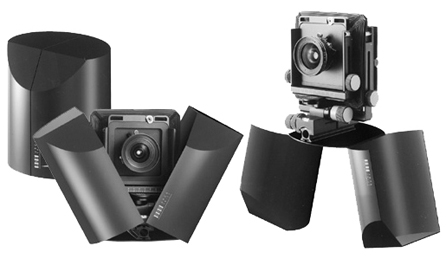
The challenge that Arca Swiss are addressing in the development of the new
Misura® Monorail "Field" View Camera is to design a metallic monorail
view camera for the International 9x12-4"x5" format and back, being both
expandable and as compatible as possible with the present Arca Swiss
system, and being also the most compact and lightest system
monorail camera on the market. The only non-compatible feature in the
Misura® is the smallest dimension for bellows attachment to the rear
standard, an intermediate dimension between the 110x110 mm of the 6x9
frames and the 171x171 mm of 4"x5" F-line frames.
At the beginning, there is a nice and very ambitious project in mechanical
engineering to optimise the existing F-line camera system in 6x9 and
9x12-4"x5", including the current "field" model based on the 6x9 front
standard, a 4"x5" rear standard and a tapered bellows (a similar model
is used by Jack Dykinga). This "field" model is already an optimisation
in weight and size with respect to the standard 4"x5" F-line with
"square" bellows. To go further in reduction of weight and size, not a
simple task, Arca Swiss has concentrated the efforts on two points:
-
reducing the size and weight of the rear standard frame to the
maximum possible, keeping a full compatibility with the well-established
International 9x12-4"x5" ground glass and cut film holders;
-
reducing the weight of the rear function carrier which features
shifts only, but no tilts nor swings.
This last point, no rear tilts nor swings (but full shifts), seems to be
the most controversial among view camera aficionados. In the
discussion, many passionate users of lightweight field cameras do not
mention the fact that many folding field cameras have only reduced
possibilities of rear tilts and swings, sometimes they do not feature
any rear tilts or swings at all and limited rear shifts, if any.
Even the legendary Linhof Technika® offers only +-20 degrees of rear tilts
and swings, but, at least there are some available. Look at the
specifications of field cameras, consider the relative tilt+shift
angle allowed combining front+back, and you'll realise that a single
Arca Swiss function carrier already offers a substantial amount: plus or
minus 35 degrees of base tilts, and plus or minus 45 degrees of swing
(in fact more than that: on Arca Swiss function carriers, swing is only
limited by the bellows). On the Misura® now in production, there are
additional tilt possibilities thanks to the Orbix® "rocking" device
built in the front standard. The combination of base tilts plus the
Orbix® allows the camera to be totally yaw-free even in the most complex
combination of tilts.
Starting from +-35 degrees allowed by base tilts, the Orbix® adds an
additional +10(up)/-15 degrees(down) amount of tilt, hence allowing a
total of +45/-50 degrees ; those figures are close to what the Linhof
Technika® offers when you do not tilt the folding base plate: +30/-30
(front standard) plus +20/-20 (at rear on camera body) to reach
+50/-50 degrees. The Technika® allows on top of this an additional
-15/-30 degrees dropbed capabilities; but who will ever need
+50/-80 degrees of total tilting capabilities?
As far as swing is concerned, the Technika® offers +15/-15 degrees in
front, for a total of +35/-35 combined with rear swings. The Misura®
offers +45/-45 in front (actually, limited by bellows only), but again
how often will one need more than 30 degrees in all tilt/swing
directions?
For example with the Misura®, you'll use most of the time the +10/-15 tilt
capability of the Orbix® to achieve a classical Scheimpflug setup in
landscape photography; you may add base tilts in a more complex
situation if you wish.
Arca Swiss function carriers are designed to firmly support up to a 8"x10"
standard without trouble. The consequence is that this part of the
system, even if it is extremely compact compared to similar devices used
by other manufacturers of monorail cameras, plays a strategic role
between the rail and the heaviest standard. Its weight is an important
part of the total weight of the camera. In order to reduce the total
weight, Arca Swiss proposes with the Misura® a lightweight system
monorail view camera for field use which is in fact less limited in
tilts and swings than many folding field cameras. Actually, the Misura®
is probably the lightest 9x12-4"x5" monorail view camera fully
expandable within a comprehensive range of parts and accessories.
Let us examine a few practical situations where rear tilts & swings are
not really necessary:
-
portrait photography: no problem, you'll probably keep the
film plane vertical and the rail horizontal, you can use any amount of
shifts, drop or rise upon request;
-
landscape photography: hardly any problem, you'll keep the
film plane vertical (except if you wish to exaggerate perspectives), the
rail is horizontal, the front tilt allows you to expand the sharpness
limits to an horizontal object plane as usual according to Scheimpflug's
rule, 10-15 degrees will most of the times be sufficient; the Misura
allows +50/-50. In a camera allowing rear tilts like the classical Arca
Swiss F-line, you could reach a relative tilt angle of 90 degrees
(2x45); this extreme setup is hardly ever useful in landscape
photography, most probably you'll be limited by lens coverage and
bellows vignetting issues. If you want to exaggerate perspective
rendition like with a rear backward tilt, with the Misura® you'll have
to tilt the whole camera upward and compensate with rear rise and front
tilts; the result will be strictly equivalent.
An additional remark. If you've read the classical textbooks on view
cameras like the course by the Canadian photographer Pierre Groulx (in
French) or the beloved Ansel Adams Trilogy ("The camera, The negative,
The print", unfortunately to French readers, they have never been
translated into French, but they are available in German) you probably
know that a very classical view camera setup consists in tilting the
whole camera downward with all movements zeroed, like with a
conventional 35mm or medium format camera, then applying a rear backward
tilt to avoid unwanted convergence of vertical lines. This is in fact an
indirect rear rise combined with an equivalent front tilt, you can
achieve exactly the same setup with any camera without rear tilts if you
are allowed front tilts and sufficient direct
rear rise capabilities with a very flexible bellows. You guess the
answer: the Misura® of course offer both features. Rise/drop
capabilities of the Misura® read as follows: total rise (front+rear):
78 mm (60+18, upward), total drop: 67 mm (85-18, downward). Shift
capabilities: front: +-30 mm, rear: +-70 mm.
-
architecture : usually for a classical architecture shot of
any building (this has been confirmed by Henri Gaud, a French
professional photographer, specialist of monastic architecture who works
like this on a daily routine), the most important movement is front
rise, the film plane being strictly kept vertical like the vertical
lines of the building... this assumes a classical building with
vertical lines ! OK now you want to apply some degree of rear swing for
perspective control (I've carefuly read the book by Pierre Groulx, I
definitely want to apply the same effect as demonstrated in the book for
Montreal's church!). No problem, but using the Misura® you'll have to
operate differently. You'll have to transfer the desired rear swing
angle to the front and apply a generous amount of shift. Be it swing or
tilts, only the relative angle between the subject, the front and rear
standards are important, not the relative angles with respect to the
rail. If you use a ball head, or even a 3-D pan+tilt head, you'll have
no trouble to compensate for the camera position.
-
complex studio shots with complex movements: clearly the
Misura® has not been designed with such subjects in mind. If most of
your work deals with studio shots with complex movements, you'd better
use a classical monorail, for example a classical F-line or any monorail
view camera with full front+rear movements.
Summary of rise/drop swing/tilt capabilities of the Misura®
|
Front base tilt |
+-35° |
|
Additional Orbix® front tilt |
+10° / -15° |
|
Front swing |
marked +-45°, limited only by bellows |
|
Front shift |
+-30 mm |
|
Rear shift |
+-70 mm |
| |
|
|
Front rise |
60 mm |
|
Total rise front + rear |
60+18 = 78 mm |
|
Total travel rear standard |
85 mm |
|
Total drop front + rear |
85-18 = 67 mm |
| |
|
|
Rail length |
32 cm, folding 15cm+17cm |
Note : in order to reach 78 mm of front rise with the 4"x5" format (actual
image size: 96x120 mm) without being limited by the lens, an image
circle of about 280 mm is needed.
Conclusions :
-
the Misura® camera without lens or film holder and without the
protective base-plate and case, weights a little more than 2kg (2.050kg,
4.66 lbs), less than the smaller 6x9 F-classic (2.1 kg)
-
when you'll start using the Orbix®, you'll probably never consider
any other kind of tilting device ...
-
a single leather bellows, extremely flexible, covers all focal
lengths from 35 mm to a 400 mm telephoto,
-
the Misura® uses the smaller 110x110 mm lensboards like the 6x9 or
the classical 'field' 6x9-4"x5" F-line models, those boards are much
smaller than the 171x171 dimension of "square" 4"x5" F-line cameras,
-
the Misura® folds inside a protective leather or metallic shell
certainly not as compact but as efficient as the folding baseplate of a
folding field camera; of course the lens can be kept mounted on the
camera.
Considering the Misura® only for 6x7 or 6x9 shots on rollfilm would be a
pity, taking into account all the optimisation done to reduce size and
weight of a system monorail camera fully compatible with the
International 9x12-4"x5" ground glass and film back. However if you are
an uncompromising "rollfilm LF photographer" and if you like panoramic
shots, adding a 6x12cm panoramic rollfilm back to the Misura® will
easily transform the camera into a "rectilinear" panoramic camera, to
which you can fit almost any lens available on the market, moreover
capable of more movements than any specialised 6x12 panoramic camera.
And if you are interested by "panoramic stitching" of any
ultra-classical panoramic landscape, say, a panoramic view of Delft, a
panoramic scene of hunters coming back home in winter, a panorama to the
Matterhorn seen from the Gornergrat or a grand view over the Great
Aletsch Glacier from Bettmeralp, Galerie Photo will kindly explain in
detail how to do it successfully...
(05/07/2004) Buy Arca-Swiss
Products on
www.arca-swiss-magasin.com
|