
[abonnement gratuit]
Contact photographe

Julie (and Johnie) J. Shimon & J. Lindemann 719 York Street Manitowoc
WI 54220 920.682.0337
www.shimonlindemann.com
Cette page
en français
biography
John Shimon (b. 1961)
& Julie Lindemann (b. 1957)
have been photographing collaboratively since the mid-1980s.
They met as college students in Madison where they formed a band,
Hollywood Autopsy.
Their prints are in numerous public collections including
The Art Institute of Chicago and the Milwaukee Art Museum.
They have photographed for publications including Fortune, Metropolis, New
York, People and The New York Times Magazine and their work has been
included in books such as Photography's Antiquarian Avant-Garde: The New
Wave in Old Processes by Lyle Rexer (Harry N. Abrams, 2002), Only Skin Deep:
Changing Visions of the American Self by Coco Fusco and Brian Wallis (Harry
N. Arbrams, 2003), and Season's Gleamings: The Art of the Aluminum Christmas
Tree (Melcher Media, 2004).
They have bachelors degrees from the University of Wisconsin, Madison
(1983), and Masters degrees from Illinois State University, Normal (1989).
They are Assistant Professors of Art at Lawrence University teaching
photography and digital processes.
Interview par
|
|
J. Shimon & J. Lindemann
by Pierre Filliquet
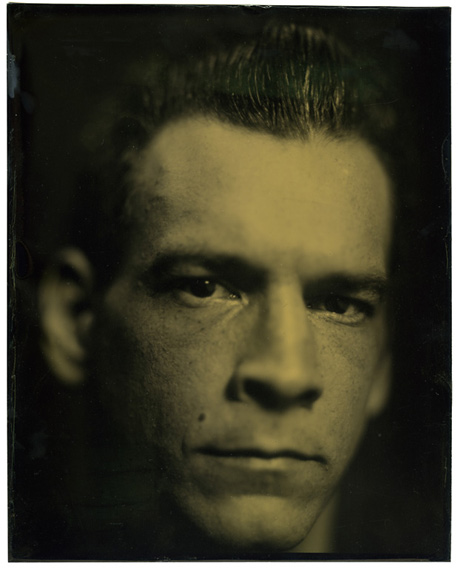
Nigel Face Tin
© J. Shimon & J. Lindemann -
2002
There is a paradox in your approach of the portrait : you are
photographing young people, often marginal but using material and
processes of old printing (8x10 and 12x20 inches. Platinum or dichromate
gums on platinum prints). Why did you choose these technics ?
A lot of the people in our photographs are
ignored by most sectors of American society. To photograph these people
and print the portraits in platinum or gum makes their existence
monumental in a quiet way. It also brings associations with history and
art history. This is counter-intuitive. Typically beautiful pictures of
flowers and exotic landscapes are printed in platinum. We're printing
pictures of cracked parking lots or people who live outside cultural
norms in small towns in the middle of America. An audience could look at
our pictures and say "who cares?" But it is this gesture of paying
attention to these people over a period of time that is at the heart of
our project. It is an ongoing narrative and we don't know how it will
end.
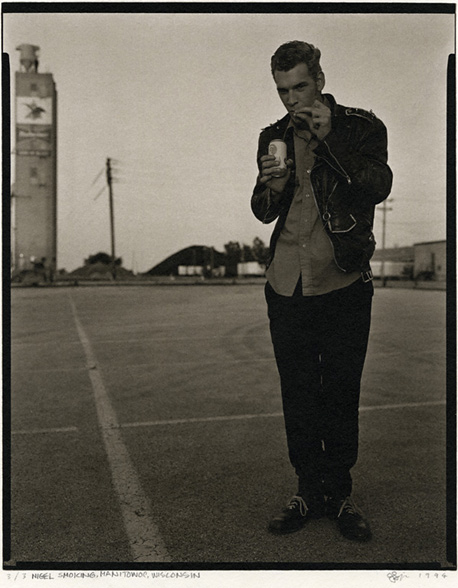
Nigel smoking
© J. Shimon & J. Lindemann - 1994
How did you learn these techniques
(shooting and printing) and which material do you use?
We are self-taught, although we have
Masters degrees in photography. We have learned from talking with elder
photographers who have critiqued our work or given us tips. And from
looking at prints in museums and emulating them. Part of our experiment
is to draw from all phases of photographic evolution to see different
things in the same manner (the contemporary through the eyes of history)
and the same things in different ways (the same subject rendered in
different processes).
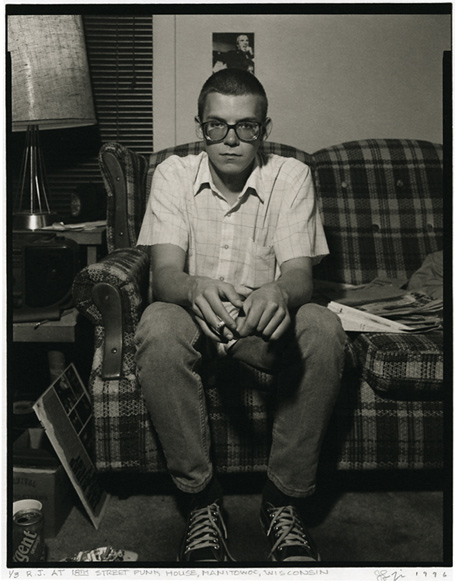
R.J. at Punk House
© J. Shimon & J. Lindemann - 1996
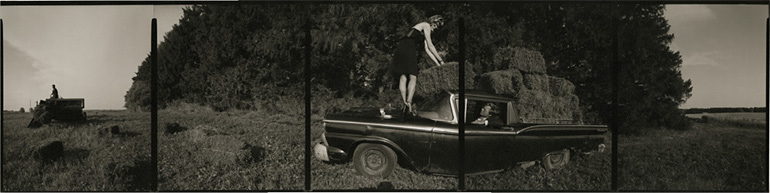
Some of your images make me undoubtedly think of film scenes
("Susan with Anne Holding Apple", "Eric with the Sun in His Ear"...)
probably because of the format in length of the 12x20, of framing. I
believe that you also practise video... What is the influence of movies
in your work ?
One of the first times we took the 12x20
camera out in the field, the man we were photographing looked through
the ground glass and said it was like watching TV. He was right. The
image looks cinematic when it is that large. Many of our videos and
films feel more like a still photograph coming to life. This is how we
see it through the ground glass while we are photographing. Films enable
our images to have movement and sound and a life that expands beyond the
single frame. Our films and videos are posted on YouTube
(http://www.youtube.com/profile?user=shimonlindemann)
and they have an affinity with experimental film more so than Hollywood
productions.
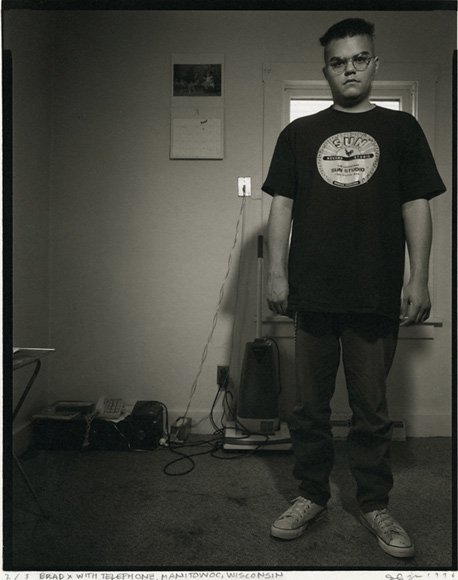
Brad X. with telephone
© J. Shimon & J. Lindemann - 1996
What is for you the importance of the
text you add to your photographs ?
We've always written about our pictures.
Maybe because they come from a specific (remote and obscure) place and
moved outward. This displacement prompted an explanation. Putting words
and pictures together presents contradictions. We accept this. The
circumstances that prompt us to make a photograph are compelling or
poetic but not always overtly dramatic or newsworthy in the media sense.
We want to remember the circumstances surrounding the photograph and we
do this by writing them down. There is always a reason to make a picture
at a given moment. We often lecture about our work and tell the stories
of the people. We saw that the stories added context for viewers who
usually thought they were "getting it" but then realized they had it all
wrong. When we designed our website in 1996, we wanted viewers to be
able to read these "stories" if they wanted to. This seemed uncommonly
voyeuristic and intimate at the time. After MySpace and blogs exploded
in the last few years, views into the personal lives of anonymous people
have become commonplace.
|
|
|
There is a deep humanity in your images.
Your subjects and the titles of your series are clear : "pictures of
non-famous people", "Midewestern rebellion". Do You think that large
format photography, with all its constraints, can be a tool for social
criticism today (work which is generally done by the report photography,
a photography which is talking about events..) ?
The view camera slows everything down.
Making these portraits enables a feeling of mutual disclosure. We have
all grown up on pictures in magazines, record album covers, shoeboxes
full of family snapshots and smiling stars on the TV and assimilate this
imagery into our own poses and how we construct and project ourselves.
Young people are especially conscious of how they construct themselves.
With the view camera, the image is captured inside the quiet wooden box
with its bellows and lens. The camera is witness. The camera must be
there, the subject must exist. It is slow and quiet. There is a sense of
intensity and focus that comes from stopping and concentrating energy.
An image is left for consideration and contemplation. Visual images
often challenge our ability to feel like we understand our surroundings.
It's the place where we most often confront illusion, the place where we
question what we see. But these questions can't be satisfactorily
answered. If we ponder this more deeply, we realize we survive based on
intuition and fate. Everything we know is an illusion.
You decided to live and work in Manitowoc
(35 000 hearts) in Wisconsin after a short passage in New York city.
Today you are shown by the Saachi gallery in London (online gallery) and
Sarah Bowen Gallery in New York... Is the way long from York to New
York ?
When we left Wisconsin for New York, we
were young and had no money or connections. We knew there was art,
music, action and a counter-culture history that we wanted to experience
directly after growing up in the quiet countryside. Our friends from the
university were moving to the East Village and we went too. Many died
from AIDs or ODs but that is another story. We visited many art museums
and galleries and were exposed to masterful gum prints by Edward
Steichen and poetry readings at the Time Cafe. After a year, we returned
to our native Wisconsin and embraced the culture and the people here. We
learned and appreciated the stories. The Sarah Bowen Gallery is in
Williamsburg area of Brooklyn and it has a fresh, experimental attitude
that provides a good context for our work so it feels comfortable to
show there. Still, because we are living in a small town and known as
photographers, hardly a week goes by that we don't get a call asking
whether we photograph weddings or pets because that's what our neighbors
perceive a photographer does.
|
|
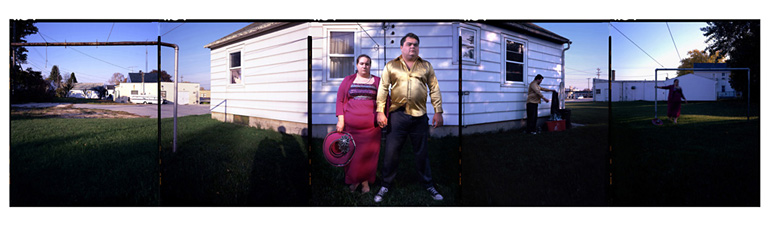
Amber Bradbackyard
© J. Shimon & J. Lindemann - 2005 |
|
|
In your last exhibitions you present large size color digital prints.
How do you consider this evolution of your work ?
Last year we were appointed assistant professors of art at Lawrence
University in Appleton, Wisconsin (http://www.lawrence.edu/).
This position has given us access to digital technology and support. We
had always wanted to make large prints from our 8x10 transparencies and
now can do it by scanning the chromes and outputting them on an Epson
9800. The intensity of the color, the scale and details of the large
prints adds a new dimension to our project. We have also recently tried
a print on demand publisher to make a small book of our photographs and
stories (http://www.lulu.com/content/393296)
and we post behind-the-scenes snapshots to flickr (http://www.flickr.com/photos/shimonlindemann/)
We see all of these technologies as important extensions of the digital
realm which makes our work in this remote small town in the American
Midwest globally accessible.
Julie (and Johnie) J. Shimon & J. Lindemann
719 York Street Manitowoc, WI 54220 920.682.0337
www.shimonlindemann.com
|
|
|
dernière modification de cet article
: 2006
|
|
tous les textes
sont publiés sous l'entière responsabilité de leurs auteurs
pour toute remarque concernant les articles, merci de contacter henri.peyre@(ntispam)phonem.fr |
 |
|



une réalisation
phonem |
|
| |
|
|
|
| |
|
|
|
| |
|